May 28, 2026 • Daniel Sato • 9 min reading time • Specs verified June 24, 2026
Woodworking Mallets: How Head Material, Weight, and Balance Geometry Affect Every Chisel Strike
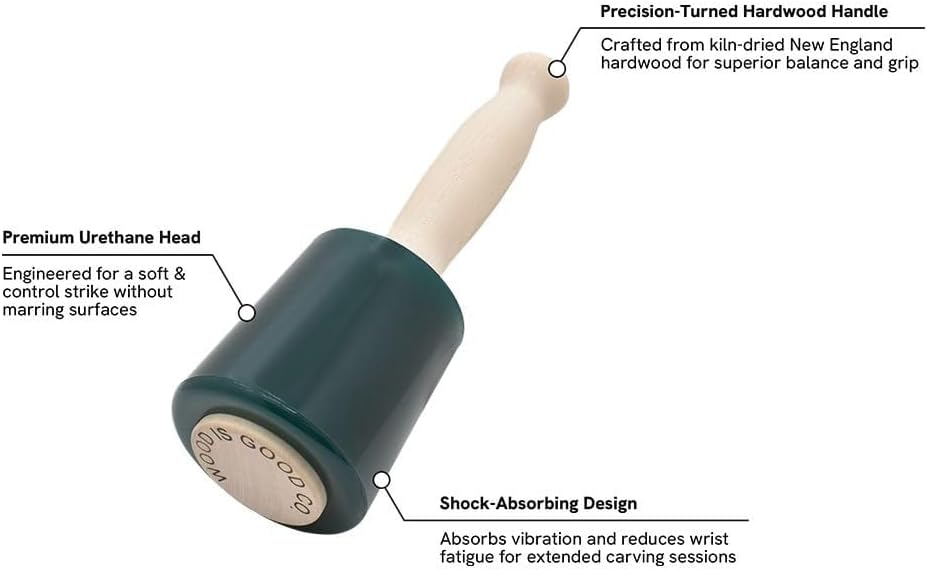
A woodworking mallet is simply a hammer-like tool with a wide, soft-ish striking face designed to drive a chisel — a hardened steel cutting blade — without damaging its handle or deflecting off the work. If you’ve ever grabbed a regular hammer to tap a chisel and felt that jarring, imprecise feedback, you already understand the problem a good mallet solves. But beyond “not a claw hammer,” mallets vary enormously: head material, weight, geometry, and balance all shape how energy transfers from your swing into the cut. Get those variables right and chiseling feels almost effortless. Get them wrong and you’ll fight every mortise. This guide walks through the design decisions that separate an adequate mallet from one you’ll reach for automatically — so you can spend your money once and get it right.
Why Head Material Is the First Decision You Need to Make
The material of the mallet head governs two things that matter more than anything else: how much energy transfers into the chisel on contact (what engineers call impulse efficiency), and how the tool feels in your hand in the half-second after impact. Your three real options are wood, polyurethane or deadblow, and brass or lignum vitae. Each makes a different tradeoff.
Wooden mallets — traditionally beech, hornbeam, or the increasingly scarce lignum vitae — absorb a small amount of the impact energy as the wood flexes microscopically on contact. That sounds like a flaw, but owners consistently describe wooden mallets as having the most nuanced feedback: the slight give lets you modulate your strike mid-sequence better than a rigid head. Fine Woodworking’s mallet coverage notes that wooden heads are the default recommendation for paring and joinery work where control outweighs raw power. The tradeoff is maintenance: wood checks and dents over years of use, and a dried-out handle can loosen in a wood head.
Deadblow mallets — a polyurethane shell filled with loose steel shot — are engineered to eliminate rebound. The shot shifts forward on impact, killing the bounce-back that can walk a chisel off your layout line. Popular Woodworking’s comparative review found that deadblow designs consistently delivered more energy per swing on through-mortises and heavy chopping work, where control matters less than consistent penetration depth. The flip side: that same dampened feedback that’s great for chopping reads as “dead” and uninformative when you’re doing fine paring work.
Brass and dense exotic heads (lignum vitae being the classic) sit in between. Brass transfers energy extremely efficiently — it’s dense enough to generate force without a large head — and owners report a clean, ringing feedback that many describe as the most satisfying of any mallet type. Core77’s ergonomics overview of hand-struck tools notes that brass mallets are popular with jewelers and instrument makers for exactly this reason: the feedback loop is tight and precise. The obvious tradeoff is cost and weight distribution; a brass head is heavy for its size, which can tire out your wrist on long sessions.
Weight and the Physics of the Strike: Showing the Math
Weight is where a lot of intermediate buyers go wrong, usually by assuming heavier is better. The physics are a little more nuanced.
The force delivered to a chisel handle is a product of head mass and the velocity of your swing — Newton’s second law applied to a striking tool. But velocity is the variable you control, and it drops off quickly when a mallet is too heavy for your wrist to accelerate effectively through a full arc. Most experienced chisel workers settle into a narrower weight range than they expect.
By the numbers:
| Work type | Recommended head weight | Why |
|---|---|---|
| Fine paring, detail work | 12–16 oz (340–450 g) | Lower mass = better velocity control at short swing arcs |
| General joinery, mortising | 16–24 oz (450–680 g) | Balanced mass-to-velocity ratio for most adults |
| Heavy chopping, timber framing | 24–32 oz (680–900 g) | Mass does the work; full-arm swing acceptable |
Wood Magazine’s mallet guide echoes this framework, noting that most furniture makers reach for something in the 16–20 oz range as a daily driver and reserve heavier mallets for when they’re cutting deep mortises in hardwood.
The secondary variable is handle length, which functions as a lever arm. A longer handle generates more head velocity from the same wrist effort — but it also makes short, controlled taps harder. Traditional English joiner’s mallets (think Lie-Nielsen’s round-headed design, or the classic octagonal beech mallet) use a relatively short handle — roughly 10–12 inches — specifically because furniture work happens close to the body. Timber framing mallets run 14–16 inches or longer. If you’re doing mostly bench work, a shorter handle almost always serves you better.
Balance Geometry: The Variable Nobody Talks About Enough
Weight and material get most of the attention in buying guides, but balance geometry — the relationship between the head’s center of mass and the handle’s pivot point in your grip — may be what separates a mallet you love from one that just works.
When you swing a mallet, your wrist acts as the pivot. For the head to travel in a consistent arc and land square on the chisel handle, the head’s center of mass needs to sit directly in line with the handle’s long axis, or very close to it. When it doesn’t — when the head is offset forward, or canted — you compensate unconsciously by torquing your wrist, which introduces inconsistency over the course of a long session.
This is exactly why octagonal or round mallet heads are designed the way they are: the geometry centers the mass symmetrically around the handle axis. Compare that to a Japanese kigoroshi (木殺し) mallet, which uses a cylindrical head that’s slightly forward-weighted by design — it’s optimized for the specific wrist motion of Japanese joinery, not a general Western chiseling style. Importing the tool without understanding that design intent is a common intermediate-buyer mistake.
Owners in long-run Fine Woodworking forum discussions consistently flag this mismatch: a mallet that felt awkward often turns out to have been a design meant for a different grip or striking angle, not a defective product.
The practical test before you buy: Hold the mallet at your normal grip point and let the head hang freely, then slowly raise it through your normal swing arc. The head should travel straight without your wrist naturally rotating to compensate. If you find yourself adjusting, the balance geometry is working against you.
How to Match Mallet Design to the Work You’re Actually Doing
Here’s the decision framework in plain terms, because the options are genuinely situational:
If you’re doing fine furniture, carving, or inlay work — paring chisels, detail gouges, controlled cuts — a 12–16 oz wood or brass mallet with a short handle is the right call. The feedback granularity matters more than raw force here. Lie-Nielsen’s round-head beech mallet (roughly 16 oz) draws strong owner praise in this category; reviewers consistently describe it as the clearest feedback of any wooden option in its price range. Veritas also offers a well-regarded adjustable-weight brass mallet that lets you dial in the head mass for different tasks — a legitimately clever design that intermediate practitioners tend to appreciate more than beginners who haven’t yet developed sensitivity to weight differences.
If you’re primarily cutting mortises in hardwood — chair legs, frame and panel work, cabinet carcases — step up to 18–24 oz in a dense wood or deadblow configuration. The extra mass means fewer strokes per mortise, which matters over a full workday. Popular Woodworking’s mallet shootout found that deadblow designs in this weight range reduced physical fatigue measurably on sustained chopping tasks compared to equivalent wood-headed mallets.
If you’re doing timber framing, green woodworking, or splitting work — go heavy, go wood, and go long-handled. The mass does the work; you’re not looking for fine feedback, you’re looking for momentum.
If you want one mallet for everything — the honest answer is that a 16–18 oz beech or hornbeam mallet with an octagonal head is the most defensible single purchase. It won’t be perfect for either extreme, but it covers 80% of bench work without fighting you. This Old House’s hand tool basics guide effectively recommends this same “general joinery” sweet spot for woodworkers who aren’t yet sure of their primary work type.
Where to Buy and What to Spend
For mallets in the serious-hobbyist-to-professional range, the premium channel matters. Counterfeit and gray-market mallets exist mainly at the sub-$30 price point on mass-market platforms, but even there, a poorly fitted handle or a head that isn’t properly seasoned can check and loosen within a year of shop use.
For Lie-Nielsen and Veritas mallets, buy direct or through authorized retailers — Highland Woodworking, Acme Tools, and Tool Nut all carry the full ranges and stock accessories. For Japanese kigoroshi mallets from makers like Kakuri or Suizan, a dedicated Japanese tool specialty dealer is worth the extra step; the fit and finish on direct-import versions from vetted sources is noticeably better than mass-channel equivalents.
Realistic price bands (as of mid-2026):
- Entry-level wood mallet (beech or ash, hardware store): $25–$50
- Mid-range shop-grade wood mallet (Narex, Crown): $45–$85
- Premium wood or brass mallet (Lie-Nielsen, Veritas, Blue Spruce): $90–$175
- Bespoke or exotic-wood mallet (custom makers, lignum vitae): $150–$350+
The Decision Rule
If you’re sitting on a purchase decision right now, here’s the if/then:
- If your work is fine joinery and furniture: 16 oz wood or brass, short handle, octagonal or round head — Lie-Nielsen or Veritas at the premium end.
- If your work is sustained mortising in hardwood: 20–24 oz deadblow or dense wood — Lie-Nielsen joiner’s mallet or a quality deadblow from the contractor-tool channel.
- If you’re not sure yet: 16–18 oz beech mallet, octagonal head, from a reputable mid-range maker like Narex or Crown. Spend $50–$75, use it for six months, and you’ll know exactly what you wish it did differently. Then buy the premium version with confidence.
The mallet is a surprisingly high-leverage purchase for the money. Get the geometry right, and every chisel strike gets cleaner. That’s not marketing language — it’s just physics working in your favor.