May 25, 2026 • Daniel Sato • 9 min reading time • Specs verified June 24, 2026
Wheel Marking Gauges: Why the Micro-Adjust Mechanism Is the Design Detail That Matters
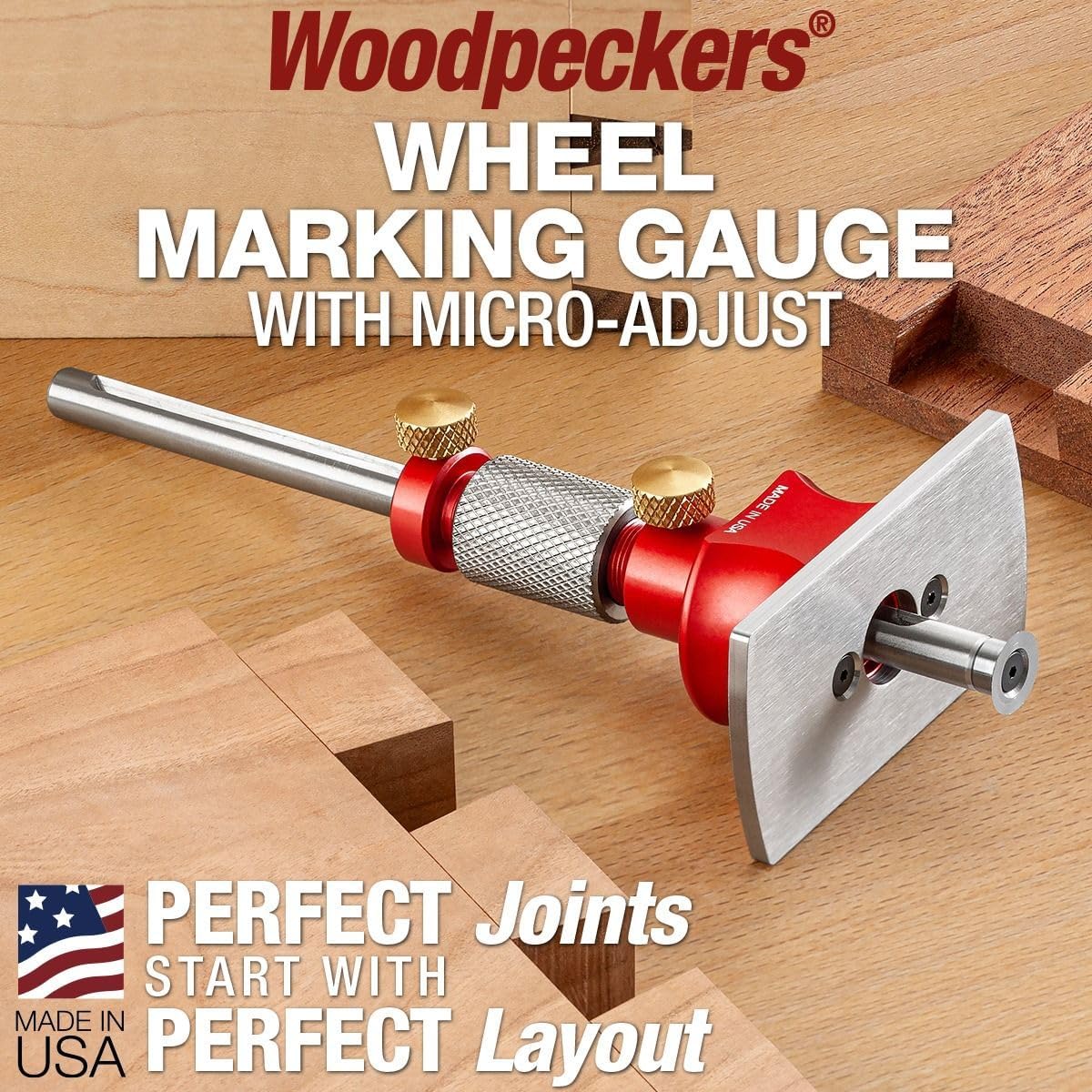
A marking gauge is a hand tool used to scribe a precise line parallel to an edge — picture dragging a sharp point or small wheel along a board’s face at a fixed distance from the fence, leaving a crisp groove that guides a saw, chisel, or router. Woodworkers use these lines constantly: laying out tenon cheeks, setting dovetail depths, marking mortise walls. The difference between a good marking gauge and a great one comes down almost entirely to how you set that distance and lock it in place. Get that mechanism wrong and the fence slips a hair every time you tighten the knob — and that hair, over a dozen mortises, turns tight joinery into sloppy gaps. This article explains exactly what to look for in a wheel marking gauge, why the micro-adjust mechanism is the single most important design feature, and which gauges at each price point have earned a reputation for getting it right.
| EDITOR'S PICK[JessEm 08801 Wood Sabre Marking](https://www.amazon.com/dp/B01BS5DJ94?tag=greenflower20-20)… | Mid-tier[Taytools 464763 Solid Brass Whe](https://www.amazon.com/dp/B081DBHZ1T?tag=greenflower20-20)… | Budget pick[KAKURI Wood Marking Gauge for W](https://www.amazon.com/dp/B08XQ5QTP6?tag=greenflower20-20)… | |
|---|---|---|---|
| Material | — | Solid Brass | — |
| Blade material | — | — | Japanese steel |
| Micro-adjust | — | ✓ | — |
| Extra cutters | — | ✓ | — |
| Max scribe width | — | — | 3.5" |
| Price | $99.99 | $35.67 | $18.80 |
| See on Amazon → | See on Amazon → | See on Amazon → |
What a Wheel Marking Gauge Actually Does (and Why “Wheel” Matters)
Traditional marking gauges used a steel pin or a knife to scribe lines. Pins are fine for softwood but tend to tear across wood grain rather than slice through it. A wheel cutter — a small, hardened-steel disc, usually 1/4” to 3/8” in diameter, ground to a sharp bevel — rolls through the fibers rather than dragging across them. The result is a clean, knife-sharp line that won’t fray when you’re chopping a dovetail baseline. Fine Woodworking’s review of marking gauges notes that wheel cutters perform measurably better than pins on hardwood end grain and figured material, where a dragging point can follow inconsistent grain rather than hold a line.
The fence — the flat plate that rides against the edge of your workpiece — is the other half of the equation. Its geometry matters: a wide, flat face registers more consistently than a narrow one, and the quality of its machining determines how square your scribed line will be to the face of the board. But once you’ve accepted that a wheel cutter and a quality fence are table stakes, the conversation shifts entirely to the mechanism that moves and locks the fence.
The Micro-Adjust Mechanism: Why This Is the Design Variable That Separates Gauges
Here’s the core tradeoff most buyers don’t think about until they’ve already spent money: every marking gauge needs a way to set a precise distance, and a way to lock that setting without changing it. These two requirements are in tension. A lock that’s easy to tighten quickly tends to introduce rotational force that nudges the fence slightly off your intended setting. A lock that’s absolutely rigid is often slow or fiddly to move.
Gauge makers solve this differently, and their solutions break into three categories:
1. Friction lock (thumbscrew or wedge only). The simplest and cheapest approach. You slide the fence to approximate position and tighten a thumbscrew. The problem: tightening the screw creates lateral force on the stem, which can walk the fence a fraction of a millimeter before it locks. At the scale of joinery — you’re often working to tolerances of 0.1mm to 0.5mm — that drift matters. Popular Woodworking’s layout-tools feature flags this as the principal failure mode of entry-level gauges, specifically on sliding-stem designs where the screw bears directly on a round shaft.
2. Rack-and-pinion or lead screw (coarse + fine adjustment). A secondary mechanism — typically a thumbwheel that threads the fence along a fine-pitch screw — lets you sneak up on a setting without moving the fence freehand. You get close, then dial in. The lock then clamps against a flat-sided stem or dovetail rail, minimizing rotational drift. This is the design approach Veritas uses on their wheel marking gauges, and it’s why that tool comes up consistently in discussions about layout precision. ToolGuyd’s review of the Veritas wheel marking gauge specifically calls out the lead screw as the feature that makes repeatable multi-piece setups practical: you can move off a setting to check a fit, then return to within a few thousandths.
3. Dovetail-rail + locking lever. A few premium makers — most notably Lie-Nielsen — machine the beam with a dovetail profile so the fence can only slide along one axis, eliminating the rotational play you get with a round rod. A lever or cam lock then clamps the fence without any twisting force on the stem. This approach is more expensive to manufacture but produces a noticeably more rigid lock-up.
The practical implication: if you’re doing repetitive production work — cutting dozens of tenons to the same depth, marking a run of cabinet face-frame parts — fence drift of even 0.2mm compounds into visible variation. The lead-screw and dovetail-rail designs aren’t overengineered luxury; they’re insurance against cumulative error.
By the Numbers
| Gauge tier | Typical stem type | Micro-adjust? | Price range (USD, 2026) |
|---|---|---|---|
| Entry-level | Round rod, thumbscrew lock | No | $20–$55 |
| Mid-range | Round rod or flat bar, lead screw | Yes (some) | $60–$130 |
| Premium | Dovetail rail or precision flat, lead screw + lever lock | Yes | $150–$260 |
Sources: Wood Magazine marking gauge roundup; current pricing at Highland Woodworking and Lee Valley as of May 2026.
The Cutter and the Stem: Two More Design Details Worth Scrutinizing
The mechanism gets the headline, but two secondary design decisions shape how a wheel marking gauge feels over years of use.
Cutter replacability and geometry. The wheel cutter is a wear item. On budget gauges, the cutter is often a proprietary shape that requires buying direct from the manufacturer — and sometimes isn’t sold separately at all. Premium gauges like those from Veritas and Lie-Nielsen use replaceable cutters that are either stocked by authorized retailers or easy to resharpen with a slip strop. The bevel angle also varies: a steeper bevel (closer to 90°) is more durable but leaves a slightly wider kerf; a shallower bevel stays sharper longer on hardwood. Wood Magazine’s gauge roundup notes that most premium-tier gauges ship with a bevel in the 25°–35° range, which strikes a useful balance for mixed-species shop work.
Stem cross-section and stiffness. A round stem flexes slightly under clamping force in a way that a rectangular or dovetail-profile stem does not. This is measurable at the bench: owners of gauges with round stems occasionally report that a very tight lock introduces a subtle bow in the stem over time, particularly on longer settings (say, 3–4” from fence to cutter). It’s a minor issue for most users, but if you’re consistently scribing at long distances — marking wide panel dados, for instance — a stiffer stem cross-section pays dividends. Fine Woodworking’s marking gauge review specifically calls out stem rigidity as a differentiator when working at distances beyond 2”.
Which Gauges Get the Mechanism Right: A Decision Framework
You don’t need to spend top dollar to get a usable wheel marking gauge. But you do need to know what you’re buying.
If you’re stepping up from a pin gauge or a $25 combination square trick and you want to feel the difference without committing heavily: the Veritas Wheel Marking Gauge (mid-range, lead screw, sold at Lee Valley and Highland Woodworking) is the most consistently praised mid-tier option across aggregated reviews. ToolGuyd and Fine Woodworking reviewers both cite the lead screw as genuinely precise in practice, not just a marketing spec. Owners report that the fence returns to a set dimension reliably even after being moved and reset. For most furniture makers and cabinetmakers running a small shop, this is the level where the mechanism becomes genuinely excellent.
If you’re running a production cabinet shop or doing fine furniture where joint tolerances are your reputation: the Lie-Nielsen Marking Gauge represents the dovetail-rail approach at its most refined. The machining is domestic (Warren, Maine), the lock is a lever cam that introduces no rotational drift by design, and the resale value on the secondhand market is strong — a gauge bought at $200 holds 60–70% of its value after five years based on pricing patterns visible in premium tool resale communities. It’s a capital purchase, not a consumable.
If you’re a contractor or finish carpenter who needs a wheel gauge occasionally but not daily: the Shinwa or Crown Tools offerings (typically $40–$75, available through Woodcraft and Amazon) use a round stem with an improved thumbscrew — not a lead screw, but better machined than pure-budget options. Owners report acceptable performance for one-off layout tasks. The tradeoff is repeatability: for single-use settings they’re fine, but for dialing in a tenon depth you’ll want to double-check after locking.
The decision rule:
- Occasional use, varied tasks → mid-tier round-stem with quality thumbscrew ($40–$75)
- Regular joinery work, repetitive settings → Veritas lead-screw design ($90–$130)
- Production or fine furniture, zero tolerance for drift → Lie-Nielsen or equivalent dovetail-rail design ($150–$260)
Where to Buy: Authorized Channels Matter Here
Wheel marking gauges are precision instruments; the tolerances that make them work are built in at the factory and can’t be recovered from a counterfeit or B-stock copy. For Veritas, Lee Valley’s own retail site and Highland Woodworking are the two most reliable authorized sources in North America. For Lie-Nielsen, buying direct or through Tool Nut ensures you’re getting a genuine instrument with a domestic warranty. Wood Magazine’s buying guide notes that gray-market imports of gauge-style tools have appeared on major marketplace platforms — the tell is usually a fence with visible casting seams and a cutter that wobbles visibly in its seat. If the price is 40% below what Highland or Lee Valley charges for the same brand, it’s not a deal, it’s a different product.
The Bottom Line
The wheel marking gauge is a small tool that earns its keep through precision, and precision in a gauge lives almost entirely in the mechanism that moves and locks the fence. A lead screw or a dovetail rail sounds like a manufacturer’s spec-sheet brag, but in practice it’s the difference between a tool you trust blindly and one you second-guess every time you lock the fence. If you’re doing serious joinery work — even a few times a month — that trust is worth real money. Start with the Veritas if budget is a consideration; move to Lie-Nielsen if you’re building furniture that needs to last and you want a tool with the same expectation.