June 18, 2026 • Daniel Sato • 9 min reading time • Specs verified June 24, 2026
Pairing Chisels and Mallets: The Weight, Balance, and Material Decisions That Make a Set Work
A chisel is one of the simplest tools ever made — a flat piece of steel sharpened to an edge, with a handle you hit. But spend any time around serious woodworkers and you’ll realize that simplicity is deceptive. The chisel you buy and the mallet (the wooden or polymer striking tool) you pair with it are actually a system, and when that system is mismatched, you feel it immediately: glancing blows, mushroomed handles, fatigue in the wrist, and work that drifts off your layout lines. This guide is for the buyer who already knows they want to step up — maybe you’re eyeing a set of Lie-Nielsen bench chisels, or you’ve been using a rubber mallet you grabbed off a shelf and something feels off. We’re going to walk through the weight, balance, and material decisions that separate a thoughtful pairing from an expensive mistake.
Why the Mallet Is Half the Equation
Most buyers research chisels obsessively and buy whatever mallet is nearby. That’s backwards. The mallet determines how energy transfers into the chisel, how much control you have over that energy, and whether the chisel’s handle survives a decade of daily use.
Here’s the core physics in plain terms: a heavier mallet delivers more energy per swing but requires more muscle to control. A lighter mallet is faster and more precise but demands more strokes for the same depth of cut. The ideal pairing depends on what you’re cutting — paring thin shavings in dovetail baseline cleanup requires a very different setup than driving a mortise chisel through two inches of hard maple.
Fine Woodworking’s comprehensive chisel guide makes the distinction explicit, separating chisels into bench chisels (general paring and light mallet work), mortise chisels (heavy, repetitive mallet strikes), and paring chisels (hand pressure only, no mallet). If you’re buying a single set and expecting it to do everything, you’ll inevitably compromise on the mallet choice. The practical answer most working woodworkers land on: one medium-weight joiner’s mallet (around 14–18 oz) for bench work, and a heavier dedicated mallet (22–26 oz) if you’re cutting mortises regularly.
Handle Construction: Socket vs. Tang, and What It Means for Mallet Choice
Before you can choose a mallet, you need to understand how your chisel’s handle is attached to the blade — because the two main designs, socket and tang, have different tolerances for impact.
Tang chisels have a pointed spike (the tang) that extends up into the handle. The handle is typically secured by friction and a ferrule (a metal ring at the base that prevents the wood from splitting under impact). Lie-Nielsen’s bench chisels use this construction with precision-machined steel ferrules. Tang chisels can be mallet-struck, but they’re most comfortable with lighter, controlled hits — the energy has to transfer through that friction joint, and repeated heavy strikes will eventually loosen the best-fitted tang handle.
Socket chisels flip the geometry: the blade end is a hollow cone that the handle sits into. The handle is held by the wedging force of the taper, which actually tightens under impact. Lie-Nielsen’s socket chisels and most dedicated mortise chisels use this design for a reason — it’s engineered for heavy mallet work. Per Lie-Nielsen’s published product documentation, socket handles can be replaced in the field without specialized tools, which matters when you’re using these professionally for years.
The decision rule is straightforward: if you’re planning to drive a mallet hard and often, prioritize socket construction. If your work is primarily bench work — fitting, paring, and joinery cleanup — a well-made tang chisel with a hardwood handle and a solid ferrule is entirely appropriate.
Mallet Materials: Wood, Lignum Vitae, Brass, and Polymer
This is where buyers get confused by options, so let’s map the field clearly.
Traditional wooden mallets (typically beech, hornbeam, or hard maple) are the default for hand-tool woodworking and for good reason. They’re light to medium weight, absorb shock reasonably well, and won’t damage handle material on an off-center strike. Popular Woodworking’s editorial coverage of bench mallets consistently points to beech as the workhorse choice — dense enough for controlled authority, common enough to be affordable. The downside: wood mallets can split or check over time, especially if they’re used in shop environments with fluctuating humidity.
Lignum vitae is the traditional prestige material — a tropical hardwood so dense it barely floats. A lignum vitae mallet rings differently than beech, transfers energy with less give, and will outlast most woodworkers. The tradeoff is cost (genuinely high, increasingly hard to source) and the fact that the near-zero flex means more shock travels into your wrist on harder strikes. For finish carpenters and furniture makers doing light-to-medium work, the practical difference over quality beech is marginal.
Brass mallets occupy a specific niche: heavy, dense, and virtually indestructible. Brass won’t bounce back the way wood does — it deadens into the chisel head with authority. They’re well-suited for socket chisels in mortise work, where you want maximum energy transfer with minimum rebound. The weight is real — a quality brass mallet in the 16–20 oz range feels substantially heavier than a same-rated wood mallet because the density is concentrated in a smaller head. Reviewers on Tool Nut’s platform and in Fine Woodworking reader forums consistently recommend brass for dedicated mortise setups, but note that it’s overkill for general bench chiseling.
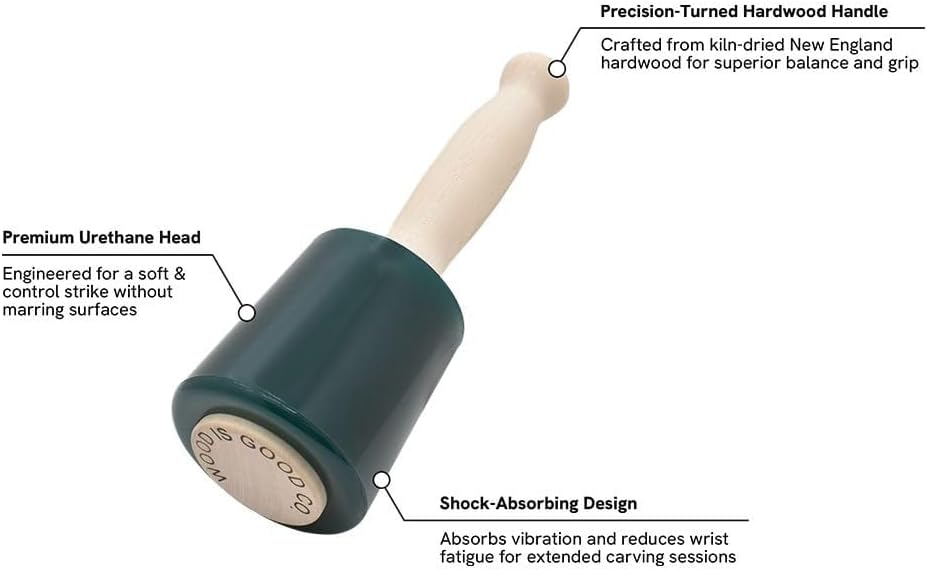
Polymer/urethane mallets are the underdog of this category. Dead-blow designs with polymer heads don’t rebound, won’t mar handles, and are largely indifferent to humidity. For contractors and woodworkers who also need to do assembly work (tapping joints together without marking) a quality polymer mallet does double duty. The criticism from traditionalists is that the feedback is muted — you don’t feel the cut as well. That’s a real tradeoff for precision work.
By the Numbers
| Mallet Type | Typical Head Weight | Best Chisel Pairing | Primary Use Case |
|---|---|---|---|
| Beech or maple wood | 12–20 oz | Tang or socket bench chisels | General joinery, dovetails, fitting |
| Lignum vitae | 14–18 oz | Tang bench chisels | Fine work, heirloom tools |
| Brass | 16–24 oz | Socket mortise chisels | Mortising, heavy stock removal |
| Polymer dead-blow | 14–22 oz | Any struck chisel, assembly | Versatile shop use, assembly |
Steel, Hardness, and What Your Mallet Does to Both
Here’s the part most buyers skip: the steel in your chisel affects how you should be striking it. This matters.
Chisel blades are typically hardened to somewhere between 58 and 64 on the Rockwell C scale (HRC) — a standard measure of steel hardness where higher numbers mean harder, more wear-resistant steel that also becomes more brittle. Veritas’s technical documentation on their PM-V11 steel (used across their chisel line) specifically notes that the alloy is formulated to sit at the harder end of the usable range while maintaining edge toughness — meaning it resists chipping better than a comparable O1 tool steel at the same hardness. Wood Magazine’s steel comparison coverage corroborates this: PM-V11 and similar modern powder-metallurgy steels hold an edge longer under repetitive mallet use compared to traditional O1, which is softer and easier to sharpen but dulls faster in hardwoods.
Why does this matter for mallet choice? Harder, more brittle steel is less forgiving of lateral force. Glancing mallet strikes — especially with a heavy brass mallet — can micro-chip a chisel edge at high hardness. With premium steel like PM-V11 or Lie-Nielsen’s A2, you want a mallet that lands squarely and consistently. A lighter wooden mallet that you can control precisely is actually the safer pairing for high-hardness premium chisels in bench work. Save the brass for your stout, thick-bladed mortise chisels made from tougher O1 stock.
Matching the Set to Your Primary Work
Let’s make this concrete with clear decision rules.
If you’re a finish carpenter or furniture maker doing primarily joinery cleanup, dovetails, and fitting: A set of tang-handled bench chisels (Lie-Nielsen, Veritas, or Blue Spruce) paired with a 14–16 oz beech or hornbeam mallet is the right combination. This covers 90% of struck work without overbuilding the setup. The Veritas bench chisels reviewed favorably across Tool Nut and Highland Woodworking’s editorial sections specifically for this use case — the PM-V11 blades and comfortable handles reward the controlled, lighter strikes this mallet delivers.
If you’re a cabinet shop owner building face frames and doing a significant volume of mortise-and-tenon work: Add a dedicated socket mortise chisel in your most common widths (3/8” and 1/2” cover most structural mortises) and pair them with a 20–24 oz brass or heavy hardwood mallet. The socket construction handles the punishment; the weight does the work so your arm doesn’t have to. Lie-Nielsen’s socket mortise chisels, per their published product specs, are sized and balanced for exactly this rhythm.
If you’re an intermediate woodworker stepping up from a budget set: The single best upgrade-to-dollar move is a quality 16 oz beech mallet paired with Narex premium chisels (made in Czech Republic, widely reviewed as the best value in the $80–$120 set range). This combination won’t embarrass you next to someone using a $400 Lie-Nielsen set on most tasks. Then, when you’ve worked enough to know what your work actually demands, you’ll have enough intuition to upgrade intelligently.
Where to Buy Without Guessing
Not every premium chisel brand is stocked everywhere, and counterfeit risk on marketplace platforms is real for sought-after brands like Lie-Nielsen. For the full professional range of chisels and mallets, Highland Woodworking, Tool Nut, and Acme Tools are the authorized premium-channel retailers the community consistently recommends. Highland in particular stocks a wide mallet selection alongside their chisel inventory, which makes in-context comparison easier if you’re buying a system rather than individual pieces. Lee Valley (the retail arm of Veritas’s parent company) is the direct source for Veritas tools and worth buying from directly for warranty confidence.
The bottom line here is simple: buy your chisel and your mallet together, from a retailer who stocks both in the professional range. Resist the instinct to optimize the blade and treat the mallet as an afterthought. The system is the tool.