May 10, 2026 • Daniel Sato • 9 min reading time • Specs verified June 24, 2026
Narex Chisels and the Cr-V Steel Question: A Design-Literate Buyer's Guide
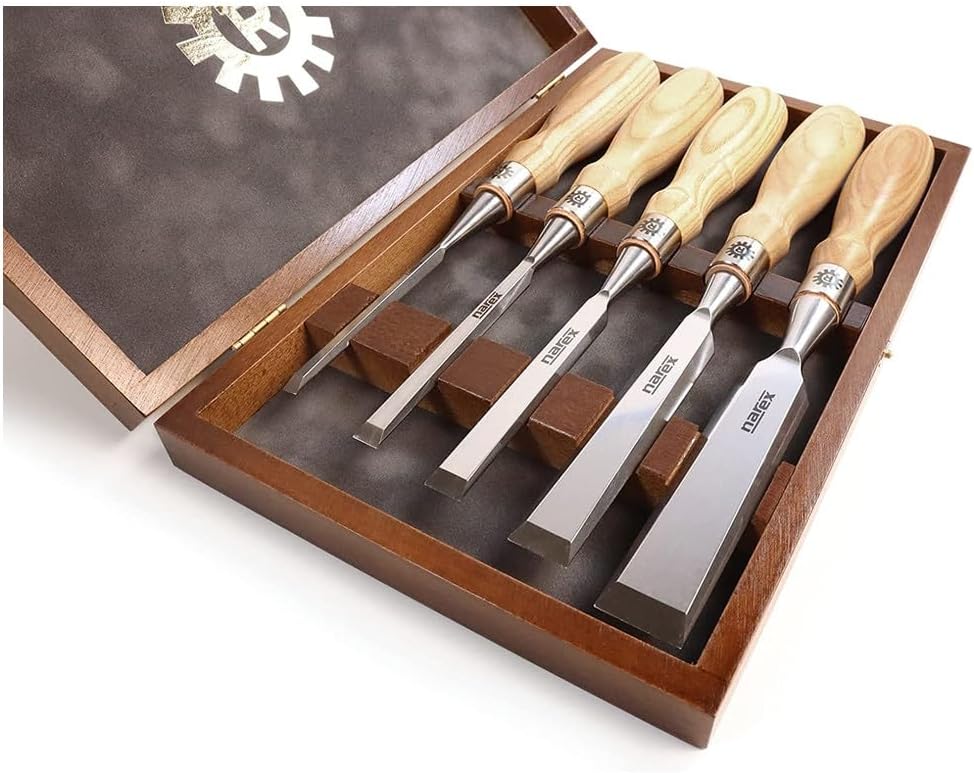
If you’ve walked into a woodworking retailer recently — a place like Highland Woodworking or Tools for Working Wood — and asked which chisels offer the most performance per dollar, there’s a decent chance someone pointed you toward Narex. Narex is a Czech manufacturer that has been making edge tools since 1919. Their bench chisels (flat-bladed cutting tools used to pare, chop, and shape wood) are widely recommended as an on-ramp to serious hand-tool work, and they sit in a pricing tier — roughly $10–$20 per chisel — that makes a full set financially realistic for hobbyists and small shops alike. But the question that keeps coming up in serious woodworking circles is about the steel: Narex uses chromium-vanadium alloy (Cr-V) rather than the high-carbon or A2 tool steel found in higher-priced chisels from Lie-Nielsen or Pfeil. Does that matter? And if so, when? This guide breaks down the design decisions behind Narex’s lineup, what Cr-V steel actually means for your work, and how to decide whether Narex is the right buy for your situation right now.
What Cr-V Steel Actually Means for a Chisel
Steel selection is one of those topics where it’s easy to get lost in metallurgy jargon that doesn’t map directly to how a chisel behaves at the bench. Let’s stay practical.
Chromium-vanadium steel is an alloy that combines carbon steel with small additions of chromium (for hardness and wear resistance) and vanadium (for grain refinement and toughness). It’s the same family of steel used in many quality hand tools — Wera and Knipex both use Cr-V extensively in pliers and screwdrivers — and it’s a legitimate engineering choice, not a compromise material. The question for chisels specifically is hardness: measured on the Rockwell C scale (HRC), where higher numbers mean the steel can hold a sharper edge longer before dulling.
Narex publishes hardness ratings of approximately 59–61 HRC for their premium Narex Premium line. That’s a credible number. By comparison:
By the Numbers
| Chisel Brand / Line | Steel Type | Rated Hardness (HRC) |
|---|---|---|
| Narex Premium | Cr-V | ~59–61 |
| Lie-Nielsen (socket chisels) | A2 Tool Steel | ~60–62 |
| Pfeil (Swiss Made) | Chrome Steel | ~62 |
| Two Cherries | Carbon Steel | ~62 |
These figures come from manufacturer-published specifications and are reported by Fine Woodworking’s chisel comparisons and Popular Woodworking’s bench chisel roundups. The gap between Narex’s top line and premium European or American chisels is real but modest — roughly within the same performance band for most woodworking tasks.
Where the steel story gets more nuanced is heat treatment. Hardness numbers alone don’t tell the full story. The quality of heat treatment — how consistently the steel is brought to temperature and quenched — determines whether a chisel holds its rated hardness uniformly across the blade, or whether there are soft spots that telegraph as disappointing edge retention after the first few sharpenings. Across aggregated community reviews on forums moderated by Fine Woodworking and commentary compiled by ToolGuyd’s Stuart Deutsch, Narex’s heat treatment is considered consistent and well-controlled for the price point, but the consensus also notes that Narex chisels require more frequent honing during a session than chisels running harder alloys like PMV-11 (a proprietary steel from Lee Valley/Veritas rated around 62–64 HRC).
The honest tradeoff: Cr-V at 59–61 HRC sharpens quickly and re-hones easily, which is a genuine advantage for beginners building sharpening skills or for production situations where you’re cycling through a lot of light paring. The tradeoff is slightly more frequent attention compared to harder steels.
Narex’s Lineup: Which Version Are You Actually Buying?
This is where buyers frequently get confused, because “Narex chisels” is not a single product — it’s a brand with several distinct lines at meaningfully different quality levels.
Narex Classic chisels are the entry-level offering. The handles are beech wood, the blades are Cr-V, and the fit-and-finish is functional without being refined. The backs (the flat side of the blade that you register against your work) typically require significant lapping — flattening on a sharpening stone — before they’re ready to use. This is common at the price point and not a disqualifier, but it’s time you’ll spend. Reviewers at Popular Woodworking note that Classic chisels can take 15–20 minutes of lapping per blade out of the box.
Narex Premium chisels step up in several meaningful ways. The handles are hornbeam (a denser, more impact-resistant hardwood), the steel specification is tighter, and — critically for experienced hand-tool users — the backs come better prepared from the factory. ToolGuyd’s coverage notes that Premium chisels typically require substantially less back-flattening than the Classic line, though they rarely arrive truly flat. The bolsters (the metal rings between handle and blade that protect the handle from mallet strikes) are more substantial, and the overall geometry is tighter.
Narex Richter Mortise Chisels occupy a specialized niche — these are stout, thick-bladed tools designed specifically for chopping mortises (rectangular holes cut to receive a tenon joint). If your work includes furniture making with mortise-and-tenon joinery, this line merits separate consideration. Wood Magazine’s chisel coverage calls out the Richter line as strong value for dedicated mortise work.
The decision frame here is straightforward: If you’re buying Narex as a first serious chisel set and you’re still building your sharpening practice, the Classic line is defensible. If you’re past that stage and you want to minimize prep time and get closer to production-ready out of the box, the Premium line is worth the modest price premium — typically $15–$30 more per set depending on the retailer and the number of chisels.
The Design Details That Separate Good Chisels from Great Ones
Steel and hardness get most of the attention in chisel discussions, but serious woodworkers and reviewers at Fine Woodworking consistently emphasize that blade geometry, handle design, and back preparation collectively matter as much as steel selection for day-to-day performance.
Blade geometry and grind angle. Narex ships their chisels with a 25-degree primary bevel, which is a conventional and sensible choice for general bench work. Many woodworkers add a 30-degree micro-bevel (a very thin secondary edge at a steeper angle) for durability. The blade cross-section on Narex chisels is relatively thick compared to, say, Japanese laminated chisels — this makes them more forgiving under mallet work but slightly less ideal for very fine paring in tight spaces.
Handle geometry. The hornbeam handles on the Premium line are octagonal in cross-section, which has a functional purpose: it prevents the chisel from rolling off the bench and gives your hand a positive registration point so the blade orientation is always intuitive. Core77’s editorial on hand tool design notes that octagonal handles are a mark of deliberate ergonomic intent — the shape transmits torque efficiently from hand to blade with less grip fatigue over a long session. The beech handles on the Classic line are more conventionally round, which is fine but not as purposeful.
Back preparation. If there’s one place where Narex’s price point shows most clearly, it’s here. Even the Premium line will typically show machining marks or a slight hollow in the back that needs to be addressed before the chisel can register cleanly on a paring cut. This isn’t unusual — premium brands like Lie-Nielsen and Veritas simply absorb more labor cost in their finishing process. The implication for you as a buyer: factor in the time to prepare a Narex set properly, and if you’re not yet comfortable on the sharpening stones, consider taking a class or watching Fine Woodworking’s video series on back-flattening before you evaluate how the chisel actually performs.
Narex vs. the Alternatives: Where It Fits in the Market
The honest competitive picture looks like this in mid-2026:
Below Narex (under $8/chisel): Hardware store chisels in this tier — most of which are not worth naming — typically run steel with no published hardness spec, inconsistent heat treatment, and plastic handles that crack under mallet use. Reviewers across Fine Woodworking and Popular Woodworking consistently advise against this tier for anyone doing real work.
At Narex’s level ($10–$20/chisel): The main competition is Ashley Iles (UK), Two Cherries (Germany), and Buck Brothers. Of these, Two Cherries and Ashley Iles carry reputations for superior out-of-box preparation, but at similar or slightly higher prices depending on where you source them. The Wood Magazine chisel comparison notes that Ashley Iles chisels typically arrive with backs flatter than Narex, which is a meaningful advantage if bench time is at a premium.
Above Narex ($35–$75+/chisel): This is where Lie-Nielsen, Veritas (Lee Valley), and Pfeil live. At this tier you’re paying for tighter steel spec (A2 or PMV-11), superior factory preparation, and in the case of Lie-Nielsen, a made-in-USA manufacturing story with strong resale value. The edge retention difference between Narex Premium and Lie-Nielsen is real and noticeable over long sessions — owners in Fine Woodworking community discussions consistently describe Lie-Nielsen A2 as requiring honing roughly half as often as Cr-V chisels of comparable hardness. Over the life of a tool you’ll use daily for years, that adds up.
Where to buy: For Narex chisels, authorized premium retailers including Highland Woodworking, Tools for Working Wood, and Woodcraft carry the Premium line and can help you select individual widths rather than committing to a set. Buying from authorized stocking dealers matters here — grey-market sourcing occasionally surfaces Classic-line chisels represented as Premium, and the difference in handle material and blade spec is real enough to matter.
The Decision Rule
Here’s the framework that makes this decision clear:
If you’re building your first serious chisel set and your sharpening practice is still developing: Narex Premium is the right call. The steel is honest, the geometry is conventional enough that your sharpening references will apply directly, and the price lets you buy a full set of six or eight widths without financial hesitation. Budget for an additional hour of back-preparation work per chisel, and treat that as part of the learning process.
If you’re a working cabinetmaker or furniture maker with a defined production pace: The math shifts toward Lie-Nielsen or Veritas. The reduced honing frequency has real value over a 40-hour work week, and both brands carry resale value that partially offsets the higher entry cost if you ever upgrade further.
If you’re adding mortise chisels specifically: Look at the Narex Richter line before defaulting to a general-purpose chisel at a higher price. The task-specific geometry is the right tool for the job, and Narex’s Richter line is competitive with options costing significantly more.
The Narex question isn’t really a question about whether Cr-V steel is good enough — it is, for most of what most woodworkers do. The question is whether the prep time and honing frequency trade-off fits your current workflow and skill stage. For many buyers reading this, it will.