May 26, 2026 • Daniel Sato • 10 min reading time • Specs verified June 24, 2026
Card Scrapers and the Burnisher Question: What Steel Grade and Flex Actually Do to Your Finish
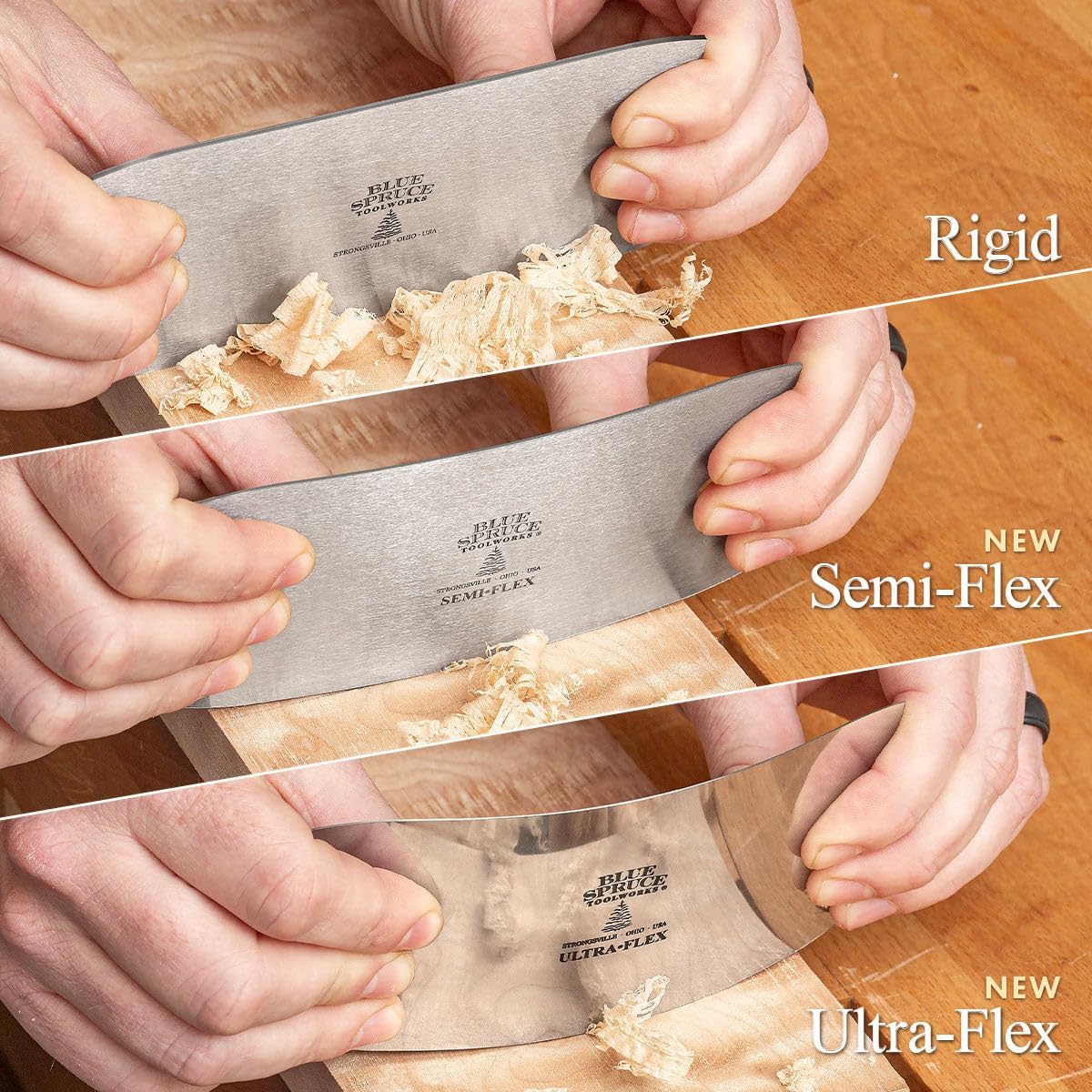
A card scraper is one of the simplest tools in a woodworker’s kit — a thin rectangle of hardened steel, roughly the size of a playing card, that you flex slightly between your thumbs and drag across wood to shave off a whisker-thin curl of material. No power cord, no sandpaper, no blade guard. Done right, it leaves a surface so clean you can go straight to finishing without touching a sheet of abrasive. Done wrong — or with the wrong steel — it leaves a fuzzy, heat-blistered mess and a very confused woodworker. If you’re stepping up from sanding everything to 220 grit and wondering whether scrapers are worth the learning curve, the answer is a clear yes. But the nuance is in the steel grade, the thickness, and the burnisher (the hardened rod you use to roll a tiny hook — called a “burr” — onto the scraper’s edge). This article walks through what those variables actually mean for the finish you get, and how to match the tool to the work.
Why Steel Grade Is the Variable Most Buyers Skip
Walk into any woodworking retailer and you’ll find card scrapers ranging from about $8 to $35 per blade. That’s not a huge price spread, but the steel underneath the price tag matters more than the dollar difference implies.
Most inexpensive scrapers are made from O1 tool steel or a low-alloy equivalent. O1 is a good baseline — it hardens predictably, takes a burr well, and has been used in scrapers for over a century. The problem is that budget scrapers are often under-hardened, typically landing in the Rockwell C 42–46 range when they should be closer to Rc 48–52 for reliable edge retention. Fine Woodworking’s guide to card scrapers notes that edge life on an under-hardened blade is dramatically shorter — you may find yourself re-burnishing after just a few minutes of work on figured maple or hard cherry, which defeats the efficiency argument for scrapers entirely.
The upper tier — tools from Lie-Nielsen, Veritas, and the Swedish manufacturer Bahco — uses steel that’s been heat-treated more carefully to hit that Rc 48–52 window. Lie-Nielsen’s technical notes on their card scrapers, for instance, specify O1 steel hardened and tempered to consistent spec across each production run, a claim that budget producers simply don’t make. That consistency means the burr forms cleanly under the burnisher, holds longer under use, and releases when you want to re-turn it rather than crumbling.
There’s also the question of surface flatness. A scraper that’s dished or warped even a few thousandths across its face won’t take an even burr. Owners of premium Lie-Nielsen and Veritas scrapers consistently report receiving blades that need minimal jointing before first use — a practical time savings that budget alternatives rarely deliver out of the box.
The practical decision frame: If you’re scraping occasionally — smoothing a tabletop or cleaning up glue lines — an O1 budget scraper from a reputable source like Bahco gets you there. If you’re running a cabinet shop or doing high-volume finish work on figured hardwoods, the step up to a properly hardened premium scraper repays itself in re-burnishing time saved within the first month.
Flex, Thickness, and What They Do to Your Surface
Here’s the variable that surprises most practitioners who’ve only used scrapers casually: thickness isn’t a minor spec. It determines how much you can flex the scraper, and flex is what controls cutting geometry.
A standard card scraper runs 0.020–0.032 inches thick. At 0.020 inches, you can bow the blade aggressively with thumb pressure alone — useful on flat panels where you want to concentrate cutting in the center and avoid chatter at the edges. At 0.032 inches, the scraper resists flex more, which actually helps on curved work or when you want a more consistent cut across the full width without accidentally digging corners.
Popular Woodworking’s card scraper fundamentals piece makes the point well: thicker scrapers are often better for beginners because the reduced flex means less chance of skewing the burr angle under pressure. Thinner scrapers reward experience — the extra flex lets a skilled user dial in the cut angle dynamically, which is exactly what you want when working with a dramatic grain reversal in quilted maple or crotch figure.
Cabinet scrapers — the handled version where a blade is mounted in a cast body, like the classic Stanley No. 80 or the Veritas cabinet scraper — remove the flex question almost entirely. The body geometry sets the cutting angle, and you’re trading tunability for consistency. Wood Magazine’s comparison of scrapers versus sandpaper found that cabinet scrapers particularly excelled on flat, wide stock where repeatability mattered more than adaptability — think drawer fronts or a set of matched cabinet doors where you need every panel to look the same.
By the numbers:
| Scraper Type | Typical Thickness | Flex Level | Best For |
|---|---|---|---|
| Thin card scraper | 0.020” | High | Flat panels, experienced users |
| Standard card scraper | 0.026”–0.028” | Medium | General-purpose finishing |
| Thick card scraper | 0.032” | Low | Curves, beginners, production |
| Cabinet scraper (bodied) | Fixed blade | None (body-controlled) | Wide flat stock, batch work |
The Burnisher Decision: Rod Diameter, Steel Hardness, and What Actually Matters
If you search “card scraper burnisher” on any woodworking forum, you’ll find confident disagreement about almost every variable. Let’s parse what’s actually structural versus what’s preference.
A burnisher is simply a hardened steel rod — often carbide-tipped or made from high-carbon tool steel — that you drag across the edge of a prepared scraper to fold over a tiny hook, or burr, that does the actual cutting. The quality of that burr is the direct determinant of cut quality.
Rod diameter. Thinner burnishers (roughly 3/16 to 1/4 inch diameter) concentrate pressure on a smaller contact area, which rolls a finer, sharper burr. This is preferred for work where you want a gossamer-thin shaving and maximum surface clarity. Larger diameter rods (around 3/8 inch) roll a slightly thicker burr that removes material faster — useful for leveling or stock removal, less useful when you’re trying to avoid any surface tearout at all.
Hardness. The burnisher must be significantly harder than the scraper — that’s non-negotiable. If you’re using an Rc 50 scraper, your burnisher needs to be Rc 60 or above, which is why carbide burnishers have become the preferred choice among serious practitioners. Veritas’s documentation on their burnisher system specifically notes that their tungsten carbide rod outperforms the older hardened-steel versions in consistency of burr formation over repeated use — owners report this tracks with experience, especially after a full day of scraping where a softer burnisher starts to deform slightly and produces an irregular burr.
Handles and geometry. A comfortable handle on your burnisher matters more than it sounds. You’re applying controlled, repeating pressure in a very specific angle — usually 5–10 degrees off horizontal — and fatigue builds quickly with a thin or poorly-balanced grip. The Veritas burnisher and the Lie-Nielsen equivalent both receive consistently positive notes from reviewers on handle ergonomics; the Lee Valley / Veritas unit in particular features a larger-diameter handle that reduces grip fatigue during extended sessions.
The burnishing angle question. This is where most practitioners developing their scraper intuition get stuck. The conventional recommendation — Fine Woodworking’s scraper guide restates it clearly — is to burnish at a very low angle (nearly flat) to produce a burr optimized for finish cuts. But on harder, more abrasive woods like teak or heavily figured walnut, a slightly steeper burnish angle (up to 15 degrees) produces a more aggressive burr that survives longer before dulling. The tradeoff is surface quality: more aggressive burr equals faster stock removal but marginally more visible surface texture. In a finishing context, that distinction matters.
Matching Scraper to Wood Species and Finish Schedule
Here’s the decision frame most guides skip, and it’s the one that separates practitioners from beginners.
Soft and medium hardwoods (pine, poplar, cherry, walnut): A standard 0.026–0.028-inch card scraper with a fresh fine burr is the right tool. The wood is forgiving enough that even a slightly uneven burr won’t telegraph in the final surface. This is the entry point for most people learning the technique.
Dense, abrasive hardwoods (teak, ipe, hard maple, ebony): These woods dull a scraper burr fast. The practical answer is either a thicker scraper (0.032 inches) that produces a more robust burr, or a carbide-edged scraper — a category led by makers like Veritas, whose carbide-edge scrapers are designed specifically for this situation. Owners working consistently with high-silica tropical species report that carbide edge scrapers extend time between re-burnishing by a factor of three or more compared to standard O1 steel on the same material.
Figured grain (quilted maple, bird’s eye, crotch figure): This is where card scrapers justify their entire existence, and why Fine Woodworking has returned to this topic repeatedly over the years. No sandpaper approach eliminates tearout on reversing figured grain as cleanly as a sharp scraper used at 45 degrees to the dominant grain direction. The key is a very fine burr — thin scraper, low burnish angle, light pressure. The result is a surface that doesn’t need sanding to achieve clarity; it’s already there.
Pre-finish vs. finish sanding replacement: If your finish schedule includes an oil or penetrating finish (Danish oil, tung oil), scraping to completion is a genuine sandpaper replacement — Wood Magazine’s comparison found scraper-prepared surfaces accepted oil finishes more evenly than sanded surfaces at equivalent smoothness. If you’re finishing with a film finish (lacquer, polyurethane, conversion varnish), scraping is still valuable for leveling between coats, but you’ll likely want at least a light final sand with 320 to avoid any directional artifact in the finish under raking light.
Where to Buy and What to Spend
For card scrapers, the value sweet spot is real: a Bahco 474 set (a well-regarded Swedish option widely stocked at retailers like Highland Woodworking and Woodcraft) costs under $20 and delivers reliably hardened steel. It’s the honest recommendation for anyone building skill before investing further.
If you’re outfitting a production cabinet shop or doing consistently high-end furniture work, the Lie-Nielsen card scrapers and Veritas cabinet scraper system are the clear step up — available through authorized retailers including Highland Woodworking, Tool Nut, and Lee Valley stores. The price difference is real ($30–$90 per scraper or scraper set versus $8–$20), but owners report that the consistency of the steel and the flatness of the finished blades shortens setup time enough to matter in a production context.
For burnishers, don’t economize here even if you do on scrapers. A carbide burnisher — the Veritas unit is the one most woodworking reviewers land on as their daily driver — runs $25–$40 and will outlast dozens of resharpenings. A cheap steel burnisher that deforms under use is the most common reason practitioners report inconsistent scraper performance.
If X, then Y:
- If you scrape occasionally on domestic hardwoods → Bahco 474 + any decent hardened steel burnisher.
- If you scrape figured or tropical hardwoods regularly → Lie-Nielsen or Veritas scraper + carbide burnisher.
- If you run a production cabinet shop → Veritas cabinet scraper system for flat stock, card scrapers for cleanup, carbide burnisher is non-negotiable.
- If you’re still not sure scrapers are for you → start with the Bahco set. The learning curve is real but short, and the quality ceiling once you’ve got the burr technique down is genuinely higher than sandpaper for most hardwood finishing work.
The scraper doesn’t care how much you paid for it. It cares whether the steel is hard enough, the burr is sharp, and you’re patient enough to let it cut rather than drag. Get those three things right, and you’ll understand why furniture makers who know better still reach for a piece of flat steel over a sheet of sandpaper.